




 Noahide


Understanding the unique symbolism in Torah of the rainbow
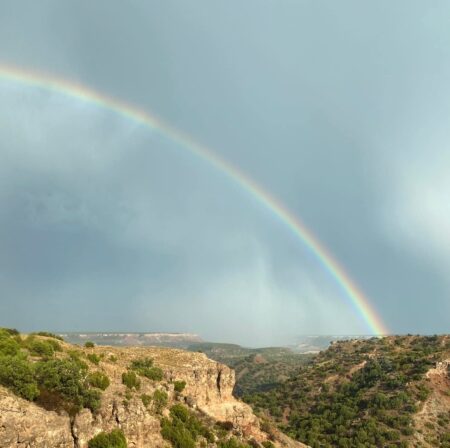
G-d assigned the rainbow as His sign of the covenant He made for mankind and all creatures after the Flood. Without a doubt, it has deep spiritual meaning. But do we know what the rainbow represents, within Torah? Are there any Torah sources that connect it explicitly with the Seven Noahide Commandments which G-d commanded then through Noah?
I asked ChatGPT, “Is there a source in traditional Rabbinic writings which explicitly says that the rainbow is a symbol or a reminder for the Seven Noahide Commandments?.”
The following is my presentation of the results of its search.
It did not find a classical Rabbinic source that explicitly identifies the rainbow – or its colors – as a symbol or reminder of the Seven Noahide Commandments.
The traditional sources make two separate points:
- The rainbow recalls G-d’s covenant that He will not destroy the world again by a flood. Genesis 9:12 states, “This is the sign of the covenant” between G-d, humanity, and every living creature.
The Talmud does not mention the Seven Commandments in this connection.
- The list of the Seven Noahide Commandments comes from other verses in Torah. Sanhedrin 56 lists them and also associates them exegetically with Genesis 2:16, not with the rainbow verses of Genesis chapter 9.
Classical explanations of the rainbow give other meanings:
- Bereshit Rabbah 35:3 associates it with a reflection or reminder of the Divine Presence and Ezekiel’s vision. (Ezekiel 1:28.)
- Ramban on Genesis 9:12–13 explains its inverted bow-shape as a sign of peace: the bow is turned away from the earth and has no bowstring from which to shoot arrows.
- Kabbalistic and chassidic sources discuss three principal colors of the rainbow – white, red, and green. These correspond to spiritual qualities (Kindness, Judgment and Mercy), rather than seven colors corresponding to the Seven Laws.
The association of seven rainbow colors with the Seven Noahide Laws does appear in modern Jewish and Noahide literature. But that appears to be a modern homiletic symbolism, not a quotation or teaching traceable to the Talmud, Midrash, Zohar, or major classical Torah commentators.
A historically careful formulation of what the rainbow represents would therefore be:
“The rainbow is the Torah’s sign of G-d’s universal covenant with Noah and his descendants. In modern Noahide literature, its seven conventionally identified colors have also been used symbolically to represent the Seven Noahide Commandments.”
—End of results from ChatGPT —
Nevertheless, it’s very difficult to accept an idea that G-d’s sign of the rainbow which He showed to Noah doesn’t have something to do with the Noahide commandments. So let’s take a closer look at the Biblical text in Genesis 9. It follows right after Noah and his family left the ark, and Noah offered sacrifices of thanksgiving.
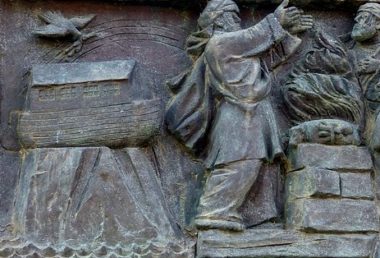
In Chapter 9, G-d begins by blessing Noah and his sons to be fruitful and multiply, and then He states to them the Seven Commandments. (In the seven verses 9:1-7, three of the Seven Noahide commandments are stated explicitly, and the other four are implicit or hinted at.) Then, in 9:8-17, G-d declares to Noah the eternal covenant He makes with mankind and all creatures. G-d reinforces that by showing him the sign of the rainbow. In those verses, G-d repeats the word “covenant” exactly seven times.
In a talk by the Lubavitcher Rebbe, he explained:
Rashi explains (on Genesis 9:9) the necessity for a sign that never again will there be a [global punishing] flood. It’s because “Noah was worried about engaging in being fruitful and multiplying”. I.e., he worried that if people would sin [as before], G-d would again bring a flood and destroy the world. Noah was not willing to engage in procreation “until G-d promised him not to destroy the world again; and so He did. And at the end He said to him, ‘Behold, I agree to make a confirmation and a strengthening of the covenant for My promise, and I shall give you a sign.’ ”
What was Noah thinking?
Noah had that worry after G-d told him the Seven Commandments for all mankind. Of course, because what would keep mankind as a whole from rejecting their commandments again? That is what they did before the flood – which is the thing that led to the flood! G-d answered Noah by revealing to him a sign – the rainbow. It symbolizes the new power for repentance and self-correction that G-d had then gifted to all people.
A person could still be immoral, or even a blatant violator of one or more of his basic commandments. Yet, he could (and many would) repent and thus be absolved for his sin.
So when a Gentile or Jew sees a rainbow, it’s first message is that we should strengthen in our commandments. It tells us that somewhere, people are violating their obligations and arousing G-d’s anger. So, we need to strengthen our observance, to tip the spiritual balance of the world in G-d’s judgment toward righteousness. But it also reminds us to repent of our own sins, and thereby become a active partner in G-d’s covenant.
– by Dr. Michael Schulman, Director of Ask Noah International